World Toilet Day: How to clean waterless urinals properly
Conserving resources and maintaining hygiene – tailored approaches make it possible
On 19 November, World Toilet Day draws attention to the importance of safe and hygienic sanitation facilities. Whilst global focus is on access to toilets and sanitation, resource-efficient sanitation solutions such as waterless urinals are becoming increasingly important. The use of waterless urinals is intended to conserve water, a valuable natural resource; however, they place specific demands on cleaning and maintenance
Unlike conventional urinals, different types of soiling occur. Limescale and urine scale deposits occur much less frequently due to the lack of flushing with drinking water. Instead, organic soiling is the main issue. For this reason, cleaning methods for conventional urinals cannot simply be applied here.
“If you want to clean waterless urinals properly, you first need to understand the system that’s been installed,” explains Jürgen Otterbein, an applications engineer at Tana-Chemie. “Every single system reacts differently to cleaning chemicals and cleaning methods.”
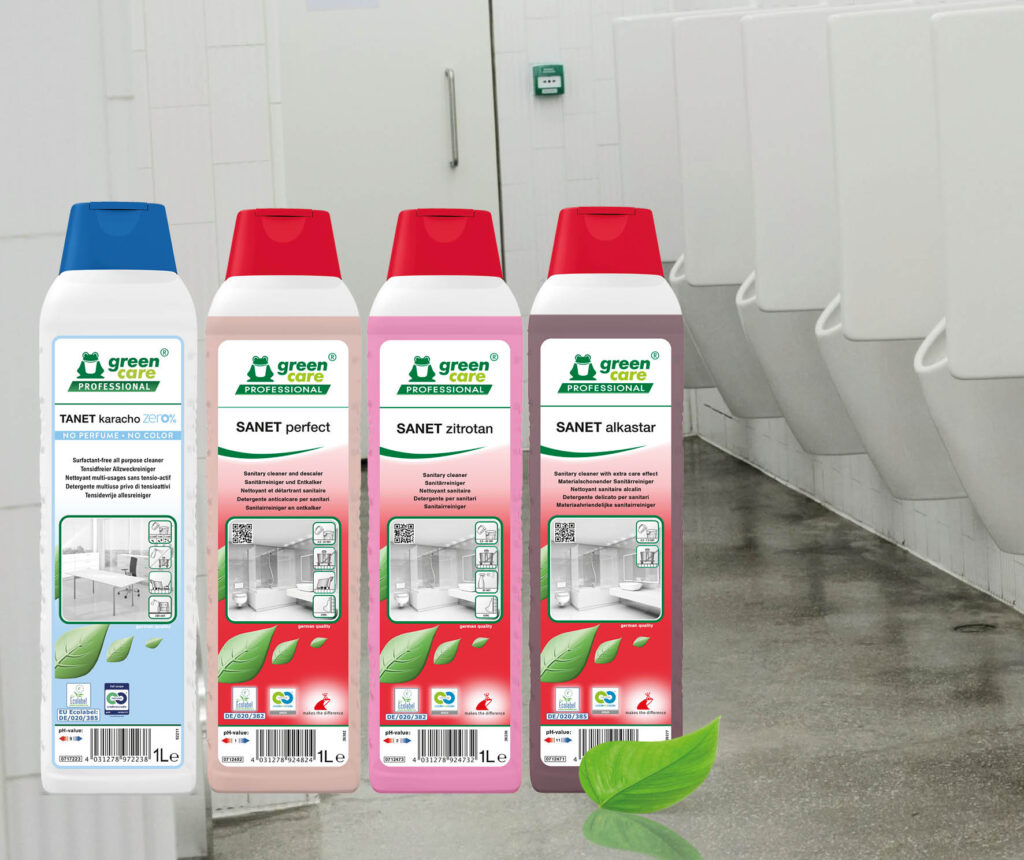
The right product concept for the properly cleaning of waterless urinal. © Tana-Chemie GmbH
Waterless urinals with an electromechanical flush mechanism
For urinals with electromechanical flushing mechanisms, cleaning can largely be carried out in the same way as for conventional urinals. As no limescale or urine scale deposits are formed by the flushing water, the focus is on removing organic dirt. Sanet alkastar is ideal for this purpose. Acid-based sanitary cleaners can be used on ceramic surfaces; for plastic surfaces, however, material compatibility should be checked, as acids can cause discolouration. Care must be taken not to damage or flood the sensor and valve area.
Waterless urinals with oil-based locking fluid
Particular care is required with systems featuring an oil-based odour trap. Undiluted surfactant-containing cleaners, whether acidic, neutral or alkaline, must not be used, as they can emulsify and thereby destroy the oil barrier layer. This leads to the loss of the odour trap and odour problems. Diluted sanitary cleaners (max. 2%) or particularly safe surfactant-free products such as Tanet karacho zero per cent are suitable for cleaning. After disinfection or cleaning, the sealant fluid may need to be topped up.
Waterless urinals with a membrane seal
In urinals with a membrane seal, the odour trap is provided by an elastic membrane. They are generally less sensitive to cleaning than systems with an oil seal. Organic dirt can be removed using suitable sanitary cleaners such as Sanet perfect, Sanet zitrotan or Sanet alkastar. Care must be taken not to damage the membrane seal mechanically. Suitable acidic cleaners can be used on ceramic urinals, whilst compatibility must be checked for plastic surfaces.
The material of the urinal also plays an important role. Ceramic surfaces are generally more resistant to acidic cleaners; for daily cleaning, products such as Sanet perfect or Sanet zitrotan are suitable, depending on the application. Plastic surfaces, on the other hand, can become discoloured if used incorrectly. Tanet karacho zero% offers a powerful, surfactant-free alternative.
To mark World Toilet Day, Green Care Professional reminds us that sustainable sanitation solutions should always be considered holistically. In addition to the technology itself, proper cleaning, the selection of suitable products and trained users all help to save water whilst ensuring the highest standards of hygiene.


